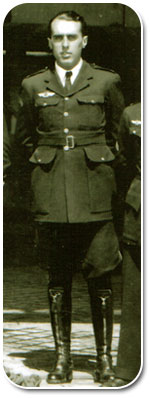
During
his student and working years he became a great specialist in
Non-visibility flights and night landings. He carried out studies in
depth on how to navigate by means of shadows and the projections of
trees and other obstacles, and gliding in different types of planes,
equipping the aerodromes for these kinds of flights.
His aeronautical life, which was remarkably intense, began on 30th
March 1925 when he was selected for a piloting course at the Civil
School of Albacete, going on to become in September of the same year a
member of the 27th class of Military Pilots in Cuatro Vientos. From the
moment of his first posting as an aviator in Melilla in February 1926,
he formed part of a team of pilots of exceptional class and
distinction, outstanding both in their professional activities and in
their zeal for all things aeronautical, and whose members included
Pedro Tauler, Joaquin García Morato, Luis Zubieta, Cipriano Rodríguez
“Cucufate”, Rogelio Azaola and Alvaro Garcia Ogara with whom he enjoyed
a close relationship all his life.
In July and August 1926 he took
a course in piloting seaplanes at the school in Los Alcazares. On
completion of this, he returned to Melilla and continued his service
until the end of the campaign, proving himself at all times to be an
officer and an airman possessed of a great sense of sacrifice, immense
physical stamina, courage and skill. His training continued with
courses in parachuting, radiotelegraphy and aeroplane mechanics –
abilities that he was to develop constantly throughout his life.
He
can also be regarded as an amateur artist of considerable note and had
practised the art of pottery. In addition to this, he played the lute
quite well. A person of artistic sensibility, a lover of the Arts, he
spoke French and English and attended all the concerts he could. In
Tablada he showed himself to be tireless, taking charge of a squadron
to increase his professional expertise. During this time all the pilots
transmitted “Don Quixote” to each other in Morse code, being
radiotelegraph operators. Most of them were versed in astronomical
navigation and knew how to use a sextant; they were totally engrossed
in their activities and ignored family distractions in order to devote
their lives to flying (Aeronautical Review Issue nº 282 and
Astronomical Review).
Haya was undoubtedly a highly imaginative individual,
who in certain cases solved problems in ingenious fashion by the simplest means; dropping
food supplies and provisions on the Santuario de la Virgen de la Cabeza, he used a rope
which ran from the cockpit and was attached to a bell. When activated by the captain, the
bell rang beside the soldiers, who then proceeded to off-load the packages manually through
the rear door of the aircraft.
On one occasion Ruiz de Alda invited him to follow his example and give
up flying to dedicate his life to the political scene in the Spain
immediately prior to 1936. Haya replied that his enthusiasm for
everything relating to aeronautics was such that he would never abandon
that profession, which serves to show how devoted he was to flying
throughout his entire life.
Haya
was an honourable man, possessed of a marked sense of duty and honour,
which led him at all times to reject suspect dealings of any kind. His
sporting spirit showed through on countless occasions, at times
combined with a very high sense of responsibility and duty.
The
story that best exemplifies this tells of when he was the official
pilot of General Franco. Asked by Franco to take him on a personal
flight, he refused owing to the dangerous weather conditions, only to
subsequently do the same journey solo to demonstrate that his refusal
was not prompted by lack of courage but rather an excellent perception
of the responsibility involved. Professional and gentlemanly, he was a
man of a serious disposition, tall and strongly built, whose regime
consisted of constant effort and the exercise of an iron will.
Disciplined, hard working and active as he was, Jesús Salas Larrazabal,
in his brief biography says that “Haya, along with Ramon Franco and
Morato, formed a trio that should have shaped the Spanish Air Force”.
|